If you're over 45, a big chunk of this documentary isn't going to be news to you: In a world awash in nuclear weapons, only one has to go bang to wipe out millions of people (minimum), or start a barrage of bombs that destroys the whole world (maximum). It's true that after the Soviet Union broke up and the Cold War was officially declared over, the idea of nuclear annihilation got put in the back of a drawer. But, as Lucy Walker points out in her clear-eyed documentary, plenty of nukes are still around, and the danger of one being used today may be even higher than last century.
The film uses archival footage to retrace how we got here -- and plenty of talking heads, including some major geopolitical players such as Pervez Musharraf, Mikhail Gorbachev and Tony Blair -- to spell out current threats. These still include an inadvertent action (an accidental launch or miscommunication), or a nuclear nation (there are nine) intentionally deploying a weapon. But new on the worry-about list are rogue players, terrorist organizations and unstable regimes that could acquire nuclear material and construct a weapon. This could be either an amateurish "dirty bomb" or a full-fledged launched device which scientists assure us isn't that hard or expensive to construct.
Countdown is a sobering film, though not without a frisson of real-life intrigue. Particularly hair-raising is the frequency with which smugglers are caught with small amounts of highly enriched uranium or plutonium. How many aren't detected?
The film's closing argument is that in failing to completely eradicate nuclear weapons, the world remains at the mercy of catastrophe either by mistake or intent. But unlike other recent take-action scare films (An Inconvenient Truth, Food, Inc.), I'm not sure what the newly informed citizen can do about it -- except, of course, not make their own A-bomb. In English, and various languages, with subtitles. Starts Fri., Aug. 6. Harris (Al Hoff) [3 out of 4 stars]
Debra Granik's slow-burn of a drama is a spare Appalachian noir told with an economy of dialogue and plot. Yet don't mistake its leanness for lack of intrigue, revelatory nature or emotional impact. The film builds to a payoff that splits the difference between heartbreaking and heartwarming, and is hard to forget.
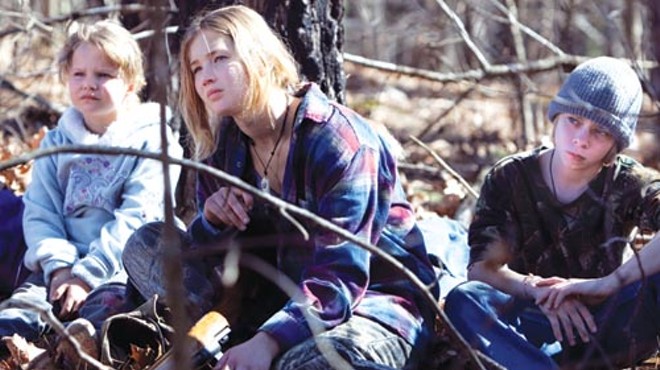
The film follows Ree, a teen-age girl living in rural poverty in southern Missouri. Her mother is incapacitated with mental illness, so Ree looks after her, the house and her two younger siblings. Her life is tough, but no more so than that of her neighbors. This is a place where opportunity or change is limited to joining the military.
Things get complicated when Ree's estranged father -- a meth cooker -- disappears before a court date, jeopardizing his bond. Ree has less than a week to produce her dad -- or proof of his demise -- or she'll lose the homestead, and her family. With her uncle, Teardrop (John Hawkes, of Deadwood), as a reluctant guide, Ree begins to untangle the fate of her father. It's a path that winds through troubling encounters with distant relatives involved in the meth trade, who are as disinclined to help as they are quick to lift a shotgun.
Jennifer Lawrence is great as the unflinching Ree, who has little time for self-pity, but also remains a child, still taken aback by life's disappointments and fate's unfairness. Hawkes, one the film's few professional actors, does fine work as her scary-sad-lost uncle.
Granik shot on location in the Ozarks, and her film is rich with shots of the bleak winter landscape and the region's remote rural corners. It can be tricky to produce a film in such a socio-economic setting that is frequently caricatured or amped up for cheap window-dressing. Yet Bone remains clear-eyed in its depiction, neither romanticizing nor vilifying its characters: Their strengths and weaknesses are all too universal; what's harder to overcome are their limited options. Starts Fri., Aug. 6. Manor (AH) [3.5 out of 4 stars]