-
-
-
Features
Just in time for the holiday season, Barack Obama's election could take us past years of political fear-mongering and divisiveness
-
-
-
News
Bloomfield fights sparking memories of the good old days
-
-
-
News
"Every time we're allowed to cut down forest, and not pay the [financial] cost of that, we're taking that capital and taking that inheritance away from [future generations]."
-
-
On The Side
Wings and things worth crossing the freeway for.
-
-
-
Dining Reviews
Bring plenty of appetite to this breakfast-and-lunch joint.
- by Angelique Bamberg and Jason Roth
-
-
-
Music Features
"It took me about two years on my original one before I got my timing right were I wanted it to be, and wouldn't make noticeable errors."
-
-
Under The Wire
"I'll go to Goodwill and buy cheap plastic toys for a dollar, then give them a bigger purpose, so I can make alien sounds with them."
-
-
-
New Releases
Round Black Ghosts have their own, distinct way of writing solid indie-rock and alternative songs.
-
-
-
New Releases
"Eight Point Turn" aurally describes a ride through a stretch of Montana wilderness.
-
-
-
Movie Reviews + Features
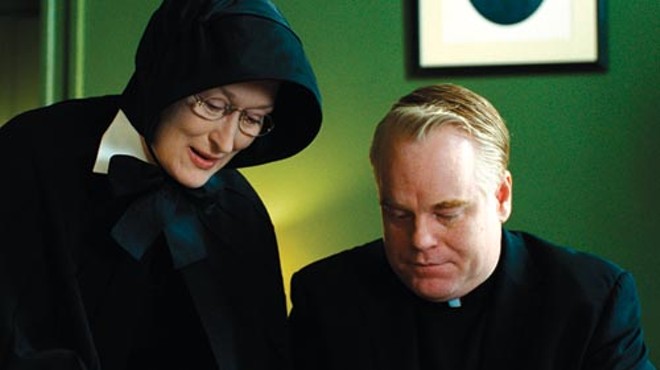
John Patrick Shanley has adapted and directs his own Pulitzer Prize-winning play about turmoil at a Catholic elementary school in the Bronx in the fall of 1964. There, the youngish Father Flynn (Philip Seymour Hoffman) is accused of improper behavior toward a student by the school's principal, Sister Aloysius (Meryl Streep). The conflict is larger than whether Father Flynn behaved inappropriately; it's also a struggle for power and authority within the rigid hierarchy of the church, which plays out even at a provincial parish like this. The primacy of the priest makes Sister Aloysius' unilateral machinations even more shocking -- or does this breech of protocol simply prove her certainty? From its opening, in which Father Flynn delivers a prescient sermon about doubt to its open-ended conclusion, the truth is never absolute. Toward this end, Doubt is structured to repeatedly toggle the audience's assessment of who is right, Father Flynn or Sister Aloysius. As in life, we can judge based only on secondhand evidence and our own biases. [3 out of 4 stars]
-
-
-
Movie Reviews + Features
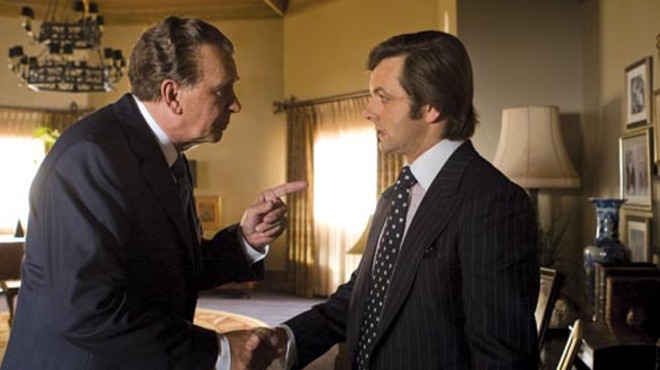
In the mid-1970s, British talk-show host David Frost set about to produce a series of televised one-on-one interviews with Richard Nixon, hoping to elicit a confession (or at least a revealing slip-up) from the former president. How these interviews came about and unfolded is the subject of this drama directed by Ron Howard and adapted from Peter Morgan's play. Michael Sheen and Frank Langella reprise their Broadway roles, as Frost and Nixon, respectively. It's a fascinating real-life episode, well worth revisiting. But its historical impact, though not unimportant, is less critical to the film than is Morgan's supposition that the heart of this match-up wasn't "news" or "truth", but two similar men fighting for supremacy. And by "winning" the interview, each man hopes to redeem his tarnished public self. Nobody ever accused Ron Howard of being a flashy director, but his workmanship is solid; the material and actors are top-notch, and Howard serves them well. The sunny Southern California setting and the busy hives of activity around the interviews help open up the play. Even though this is essentially a two-men-in-a-room-talking drama, it never feels confined to that. [3 out of 4 stars]
-
-
-
Movie Reviews + Features
Two films examine how life under duress in Germany during -- and long after -- World War II
-
-
-
Movie Reviews + Features
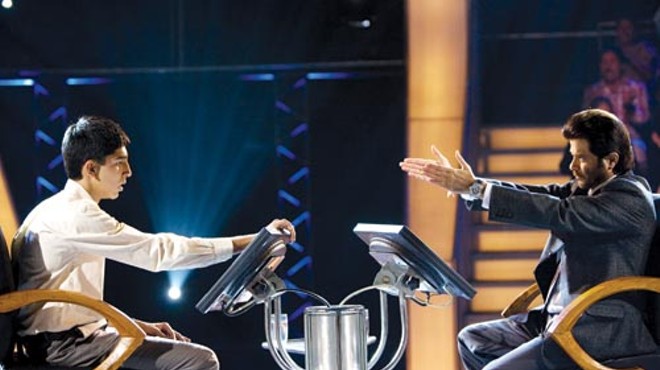
The best way to make the slums of India interesting to the 18-to-24 demographic is to hire Danny Boyle to direct a movie about them, and then to make sure he directs it like a Danny Boyle movie. Slumdog is loud, fast, brutal, kinetic and IN YOUR FACE! The first half is too good even for a hack like Boyle to ruin, and much of the second half is too ill-conceived for anyone but a serious filmmaker -- which Boyle isn't -- to salvage. But it's certainly entertaining. The premise is both simple and, despite itself, an allegory about karma. Low-level worker Jamal is 18, and when we meet him, he's one question away from winning 20 million rupees a TV quiz show. In flashbacks, we see how events his troubled youth coincidentally provided the correct answers he now gives. Slumdog Millionaire has nothing to teach or prove after its first hour. It only needs to please its audience, which takes another hour, apparently the length of time necessary to make us forget the sight of an Indian outhouse. In English, and some Hindi, with subtitles (HK) [2.5 out of 4 stars]
-
-
-
Movie Reviews + Features
At the screening I attended, I could hear the audience snuffling, but I found David Fincher's overly long, glossy account of one man's odd life to be more emotionally distancing than engaging. Liberally adapted from F. Scott Fitzgerald's short story by Eric Roth (whose Forrest Gump this film remind me of), the film tells the instructive tale of a baby named Benjamin Button, born old but who, as he grows up, becomes younger. Button is mostly played by Brad Pitt through the magic of make-up and digitally appending his head to tiny wrinkled bodies. In a series of episodes -- intercut with an awkward dying-woman-recollects framing device -- we follow Button from his childhood in a New Orleans old-folks home (how convenient), through World War II adventures and his mid-life romance with a ballet dancer (Cate Blanchett). While entertaining as a large-scale fable, Button's story left many quirky details (a backward-running clock, a pygmy) unexplained, while blithely adding contrivances (Hurricane Katrina; a useful inheritance). Pitt is game (though you could feel the audience relax when he achieved his mid-life perfect Brad Pitt-ness, sunburnished and lounging in vintage khakis), but Blanchett seemed an awkward fit throughout. Button presents a mildly interesting idea juiced with a lot of greeting-card sentiment and golden light. Its point doesn't seem especially illuminating: We all age (or unage), and that process is rife with regrets and loss. But living life in reverse doesn't change the basic mechanics of the human condition, just as a clock that runs backward doesn't change the fact the time still moves forward. (AH) [2.5 out of 4 stars]
-
-
-
Movie Reviews + Features
Tomas Alfredson's drama is an intriguing hybrid of coming-of-age story and horror. Set in the early 1980s in wintry Stockholm, it details the budding relationship between a pair of 12-year-olds: Oskar, the wispy blond boy who is a perennial victim of bullying classmates, and Eli, a dark-haired girl who only comes out at night. We quickly deduce she's a vampire -- she says right out, "I'm not a girl" -- but Oskar is thrilled to have a friend and an unlikely protector. The film has the moody, spare vibe of a Scandinavian indie with kitchen-sink themes, with just a jolt of bloody violence (briefly shown). It's less a vampire film than a disquieting, sensitive portrait of outcasts; thus, there's something both sad and matter-of-fact about these kids suffering through the miseries of pre-adolescence. (This includes the worst field trip ever.) The title is a play on one of the rules of vampiredom, which states that vampires can't enter unless invited. But in this story, invitations must be mutually considered, and the taking of a life has more variations than you initially suspect. In Swedish, with subtitles. Harris (AH) [3 out of 4 stars]
-
-
-
Movie Reviews + Features
Newspaper columnist John Grogan (Owen Wilson) and his wife (Jennifer Anniston) adopt a Labrador puppy, known formally as "Marley" and informally as "the worst dog in the world," for his rowdy behavior. David Frankl adapts Grogan's popular eponymous memoir that tracks Marley's lovable and frustrating antics as the pooch's life coincides with relatable bumps and triumphs of Grogan's own life: new jobs, new kids, new homes and, along the way, new appreciations of his normal, middle-class, middle-age existence. Wilson and Anniston may be a tad too glossy (albeit with oh-so-perfect shaggy hairdos) to remind you of your actual neighbors, but each gives an amiable portrayal. (A nod should go to the several dogs, along with their trainers, who convincingly play Marley: For this film, good dogs had to learn to act bad.) A pleasant movie for the holidays -- it's less frantic than the trailers make it appear -- though the sensitive should be forewarned: Marley's final hours get a lot of coverage. (AH) [2.5 out of 4 stars]
-
-
-
Movie Reviews + Features
Will Smith tries hard -- bless his heart -- but his innate likability and earnest dedication to looking deeply miserable here can't raise this film from its maudlin doldrums or plot holes. Smith portrays a Los Angeles IRS agent seeking personal redemption through an extreme pay-it-forward scheme that dramatically changes the lives of seven strangers, including a young woman (Rosario Dawson) with whom he makes a love connection. Simply having good intentions -- this film is inspirational times seven -- doesn't excuse director Gabriele Muccino from piling on the plot contrivances, taking laughably bad emotional short-cuts and delivering -- in total seriousness -- one of the most ludicrous death scenes ever. In the indie version I was idly re-writing in my head while watching, it's Smith and Dawson alone who build a bittersweet relationship based on shared suffering, with not a single overly fabulous beach house or dramatic rainstorm in sight. But in this pure Hollywood film about life, death and life after death, nuance is the first casualty. However, if you're a fan of the other-sort-of-disaster movie -- those toxic enough to take down a well-meaning A-list star -- Seven Pounds is the season's most unintentionally head-smacking film. (AH) [1.5 out of 4 stars]
-
-
-
Movie Reviews + Features
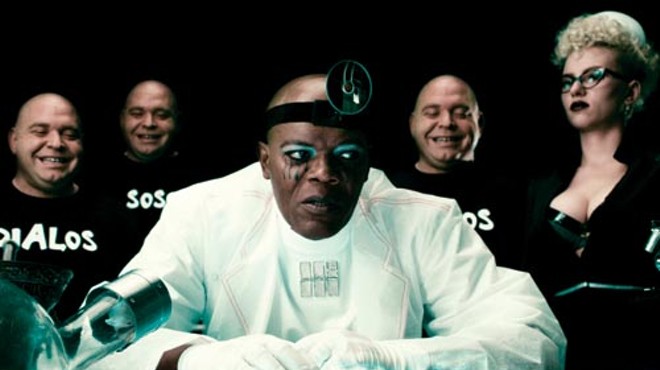
I've never read Will Eisner's classic original comic, so I have no opinion about how this film may or may not mangle the source material. What I saw was a stylized, retro-ish actioner by Frank Miller, similar in look to his 2005 film Sin City (lots of graphic-novelish black and white with splashes of color, and kinetic direction). There's a sort-of dead, mildly existential cop who fights crime as the masked Spirit (Gabriel Macht), and who continually takes on his nemesis, a sort-of dead villain named The Octopus (Samuel L. Jackson). There is a McGuffin about valuable lost relics, but that plot device is simply an excuse to line up all the colorful players, including two curvy females (Eva Mendes and Scarlett Johansson), and let them ham up the snappy dialogue. It's compact, fast-moving and agreeably silly (like a very intense TV Batman episode); the violence is comic and all characters prove remarkably hearty. (AH) [2.5 out of 4 stars]
-
-
-
Art Reviews + Features
Curator Suparak has demonstrated a knack for exhibiting the work of those who require a hyphenated addendum to the word "artist."
-
Dispatches from the blogosphere: Where have all the bloggers gone?
-
-
Potter's Field
P-G layoffs a sign of things to come
-
-
-
This Just In
Highlights from the local TV news: Return policies revealed!
- by Frances Sansig Monahan
-
-
-
Book Reviews + Features
Spotlight Events
-
-
-
-
Mondays-Fridays. Continues through May 24
-
-
Sat., May 25, 9:30 a.m.-7 p.m.
-